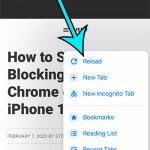
To reload a page in Chrome on your iPhone, tap the More button (three dots) and then tap Reload. Chrome asks the website for the page again and redraws it, which picks up new comments, prices, scores or anything else that changed since the page first loaded.
These instructions are for the current Google Chrome app on an iPhone running iOS 27. Google’s Chrome Help says the app works on iOS 18 and later, so if your iPhone is on something older, the menus described here may not match what you see.
What reload does (and what it doesn’t)
Reloading, also called refreshing, simply loads the same web address a second time. It does not close the tab, sign you out of the site, or delete your history. It is the first thing to try when a page looks stuck, an image fails to appear, or you expect new content that isn’t showing.
A reload is not the same as clearing your cache. The cache is a store of images and files Chrome keeps on your iPhone so pages open faster next time. A normal reload can still use some of those stored files. If a page keeps showing an old version after several reloads, the cache method later in this article is the stronger fix.
Reload a page from the Chrome menu
This is the route Google documents for iPhone in its Chrome Help page on connection and loading errors.
- Open the Chrome app and go to the tab with the page you want to refresh. If you have many tabs open, tap the tab switcher button to pick the right one.
- Tap More, the button with three dots. On iPhone it sits in the toolbar at the bottom of the screen. If the toolbar has disappeared while you were reading, scroll up a little and it should slide back into view.

- Tap Reload in the menu that opens.

The page goes blank or shows a progress bar for a moment, then loads again from the top or from close to where you were, depending on the site.
Other ways to refresh in Chrome
Pull down from the top of the page
Many people refresh with a gesture instead of the menu. Scroll to the very top of the page, then drag the page downward with one finger. A small row of icons appears, with the reload arrow in the middle. Keep pulling until the reload icon is highlighted and let go.
Google’s Help pages don’t describe this gesture, so treat it as a shortcut rather than the official method. If dragging down only scrolls the page or opens something else, use the menu route above, which works on every page.
Open the page in a fresh tab
If a page appears frozen and the menu doesn’t respond, copy the web address from the address bar, open a new tab with More and New Tab, then paste the address and go. This loads the page from scratch in a clean tab, and you can close the old one afterward. Tidying up stray tabs also helps, and you can close every Chrome tab at once on your iPhone if things have piled up.
If you use an iPad
The iPad version of Chrome shows a Reload button directly to the left of the address bar, so you don’t need the More menu there. On iPhone, Reload lives inside the menu.
When a normal reload doesn’t fix the page
Sometimes the page still looks wrong after a reload. Work through these in order, checking the page after each one.
- Check the address. A typo in the web address can load an error page no matter how many times you refresh. Tap the address bar and look carefully.
- Check your connection. Open a different website. If nothing loads, the problem is your Wi-Fi or cellular data, not the page. Make sure Airplane Mode is off. On public Wi-Fi in a cafe or airport, you may need to sign in on the network’s own page before any site will load.
- Try Incognito. Tap More, then New Incognito Tab, and open the same page there. Incognito starts without your saved cookies, so if the page works there, stored site data in your normal tabs is the likely cause. Google explains this mode in its Incognito help for iPhone and iPad. When you’re done testing, here’s how to leave Incognito mode on an iPhone.
- Quit and reopen Chrome. Open the App Switcher, find Chrome, and swipe up on it, then reopen it from the Home Screen. Apple describes this in Quit and reopen an app on iPhone.
- Update Chrome. Open the App Store, tap your picture, then tap App Updates and look for Chrome. Apple’s steps are in Update apps from the App Store on iPhone.
Clear Chrome’s cache, then reload
Chrome for iPhone has no separate “hard refresh” button like the one on a computer. The closest equivalent is deleting the stored files and then reloading, which forces Chrome to download a fresh copy of everything.
Before you start: if you also select cookies, Chrome signs you out of websites, and you’ll need to log back in. Selecting only cached images and files keeps you signed in. Leave saved passwords alone unless you really mean to remove them.
- In Chrome, tap More, then tap Delete Browsing Data.
- Next to Time Range, choose how far back to go. Google notes the default is the last 15 minutes, which may not reach the files causing trouble, so pick a longer range such as the last hour or all time.
- Tap Browsing Data and select Cached images and files. Deselect anything else you want to keep, such as browsing history or cookies, then tap Confirm.

- Tap Delete Browsing Data.
- Go back to the page and tap More, then Reload.
Google keeps the current version of these steps in Delete browsing data in Chrome for iPhone and iPad. Pages may open a little slower right afterward while Chrome rebuilds its cache. That’s normal.
Error messages you might see
Chrome shows a short code when a page can’t load. A few common ones on iPhone:
- ERR_INTERNET_DISCONNECTED: your iPhone has no internet connection. Reloading won’t help until you’re back online.
- ERR_CONNECTION_TIMED_OUT: the site took too long to answer. Wait a minute and reload.
- ERR_CACHE_MISS: the page needs information you entered earlier (for example, a form) to be sent again.
- Aw, Snap!: Chrome had trouble loading the page. Reload once, and if it keeps happening, quit and reopen Chrome.
Google lists more codes in Get help with common error messages in Chrome.
How to tell the refresh worked
The quickest check is whatever made you reload in the first place: the missing image now shows, the new message appears, or the score has changed. For pages that look the same, look for a timestamp or “last updated” line on the page. If the page displays an error code instead, use the list above to see whether the problem is your connection or the site itself.
There is nothing to undo after a normal reload. If you cleared cookies along the way, simply sign back in to the sites you use. Your bookmarks and saved passwords stay put unless you chose to delete them. To get back to a page you reload often, bookmark it from Chrome’s More menu.
Refreshing a page in Safari instead
If you also browse with Safari, Apple’s method there is a gesture: pull down from the top of the page. Apple covers it in Browse the web using Safari on iPhone. Safari’s cache is cleared in the Settings app rather than inside the browser, and the site has a walkthrough on deleting cache on an iPhone if you need it.
Questions people ask about reloading in Chrome
Will I lose what I typed if I reload?
Possibly. Text you’ve typed into a comment box, search form or message field that hasn’t been sent yet can disappear when the page reloads. Copy anything long before you refresh. On checkout or payment pages, avoid reloading after you’ve tapped a submit button, because some sites may treat the reload as a second request; check your email or account for a confirmation first.
Why did Chrome reload a tab on its own?
When you return to a tab you haven’t looked at in a while, Chrome sometimes loads it again. iPhone manages memory for apps automatically, and older background tabs may need to be loaded fresh when you come back to them. It isn’t a sign that anything is wrong.
Can I make a page refresh automatically every few minutes?
Chrome for iPhone has no built-in auto-refresh setting. Some live pages, such as sports scores or flight trackers, update themselves while open. For everything else, reload by hand. Be cautious with third-party “auto refresh” apps, which are separate browsers and see everything you open in them.
The page asks to allow a pop-up when I reload. What should I do?
Some sites open sign-in windows or payment forms as pop-ups, and Chrome blocks those by default. If you trust the site, you can change Chrome’s pop-up setting on your iPhone and reload the page.
Next time a page looks stuck, start with More and Reload, and keep the cache-clearing steps for pages that refuse to update after that.

You must be logged in to post a comment.